




Wave Music Genre Analysis
- Apr 22, 2019
- 13 min read

("SKIT & KLIMEKS // Azimuth", 2017)
Wave music is an internet born genre of music that has recently started gaining traction in the last couple of years. Wave is a type of electronic music that is commonly spread through the social media platform Soundcloud, and often consists of: Emotive Synths, Detuned Saw-tooth sub-basses and vocal chops, all layered underneath trap style beats.
When explained like that, it kind of sounds like a lot… In a nutshell I usually describe wave music as futuristic, (arguably sad) trap music. Some popular examples of wave music artists are often considered to be original artists such as Kareful, HNRK, Klimeks, and Skit (Plant, 2017).
Wave music can often be interwoven with two other similar, pre-existing genres of electronic music; Witch House and Future Garage. Wave Music sounds to be almost like a mix between the two genres, and oftentimes ‘Wave’ artists will play Witch House and Future Garage songs in their live sets, and the same with Wave podcasts and radio shows, such as on Liquid Ritual, a popular radio show and now record label that seems to be the current front of the wave music genre.
Though these genres share a lot of similarities there are a couple of key things that can seperate the three genres, later on I’ll discuss the similarities and differences but first it makes sense to look more in depth into the background of wave music
BACKGROUND OF WAVE MUSIC

("Noble People | Kareful", n.d.)
At the moment the frontman of the wave music scene seems to be Kareful and his record label, Liquid Ritual. An example of a traditional wave music track would probably be 'H2o' by Kareful, as this is considered by some to be the most definitive track showcasing the sound of the wave scene, and it is also one of the more popular tracks around.
If we listen to H2o we can pick out a couple of sounds that are commonly found throughout the genre. For comparison I will also pick another popular wave track, “Pixel” by MYSTXRIVL & SOKOS, which I believe showcases some of the more intense (and sometimes cinematic) sounding parts of wave music, whereas some (such as H2o) opt for a more relaxed, smoother and peaceful sound. That being said, descriptors such as cinematic and intense or relaxed and peaceful are subjective and could be considered to be different things to others.
I’m particularly referring to the rate of the rhythms, harshness of drums (ie the distortion in the drums and glitchy samples found in Pixel, compared to H2o) and intensity of synths and overall sounds (H2o uses more minimal synths and sounds, Pixel uses quite bright, complex synths). This is an important thing to note in Wave music as these are some of the things that separate the songs in the genre, some people will be fans of, and will opt into more intense wave tracks (for instance I personally tend to lean more on this side of the genre) and some are more into the softer, ‘chill’ sounds.
To me personally, one of the most identifiable features of wave music are the use of detuned saw-tooth “Reese” basslines. I found a really interesting video which has a bit of background on what a Reese bass is and how to make it, including the origin (which is believed to be from the 1988 song called “Just Want Another Chance” by an Artist called Reese)! (Palmer, 2018)
At the very start of the video we hear a snippet of what a Reese bass sounds like, and this is the type of sound that can be heard commonly throughout wave music. This can be heard at 26 seconds in H2o, and at 13 seconds in Pixel. These seem to be a kind of driving element in wave music and what I believe is one of the main foundations of the sound. That being said, in some tracks of the genre there are use of 808 basslines instead of Reese basses, but a Reese bass could be used as an example of a typical wave sound. Some songs will use a combination of the 2 types of bass sounds - for instance in H2o, at 55 seconds it switches from a Reese to an 808 bassline.
Another very identifiable feature of wave music is the use of trap / modern hip-hop drums. The use of 808 drums are very popular in modern hip hop music to the point its scene all over the place. To use an example of this for those who (have been living under a rock) don’t know what a trap style drum sounds like I will provide an example below. Upon searching “trap artists” on google the first artist to appear was the rapper Future, so I’ve picked one of his songs that demonstrates this.
We can hear that these same style of drums are used on both H2o and Pixel, and Pixel uses the typical trap snare pattern that can commonly be heard throughout hip-hop music.
Both of these common elements are often layered with manipulated vocal samples (usually pitched and stretched to create melodies) as well as the use of melodic synths and very large reverbs which all come together to the sound of wave music.
When vocals (as in outside of chopped vocal samples) are used in wave music, many times they are heavily auto-tuned, though autotune is already a very common feature in many Soundcloud rap / trap vocalists. We can here an example of this at around 3 minutes and 45 seconds of this mix:
(I had to include a link to a mix as the original version of this track can’t really be accessed anywhere else online anymore. This is something that happens every now and then in wave music, but I will discuss this more later.)
We can also hear an example of auto-tuned vocal chops here:
One thing I noticed with wave tracks is a very common chord progression that can be heard all throughout the genre, which is the VI,VII,I,IV progression. Although there are usually variations of this, the first 3 VI, VII, I chords can be heard very commonly, particularly in the bassline.
Check out these examples of tracks I've found with this progression:
OBSCURITY AND SIMILARITY TO OTHER GENRES
Since Wave music is a fairly new and still rather obscure genre of music, it can come with a lot of grey areas and issues with defining the genre. Though I’ve attempted to make a classification, as expected with any genre of music, there are likely to be a lot of variations in sound. For instance it’s kind of like rock music, I could look into and describe a typical rock track but there are still going to be different sounding things, for example, does a rock band mean a band that sounds like The Beatles? Or a band that sounds like AC/DC? They’re both ‘rock’ but vastly different sounding.
Though wave music is much more specific and narrowed down than a genre like rock, there are lots of times where a song might not necessarily be classified as a wave song, but the wave fanbase will tend to gravitate towards it.
Soundcloud artists seem to gain popularity by other people sharing their music and this is how the Wave music scene has likely built up its range of artists, usually wave artists gain popularity by being featured on a radio show / mix or will be shared via other peoples profiles. This can sometimes be the case where a song will sound like a wave song, and will have a wave fanbase listening to it, even though the artist hasn’t necessarily tagged it as wave. This is a common thing to happen in new genres of music, especially as most are being born in the internet age where genres are becoming more obsolete.
An example of what I’m specifically talking about is if we look at this song below we can see that it shares many wave characteristics, it has also drawn in a fanbase of wave music followers and artists such as Kareful himself (we can see this in the comments section), despite not having any tags relating to wave.

This demonstrates the ambiguity of the Soundcloud trap scene as there isn’t really a yes or no answer. Wave music could also be considered a sub genre of music spawning from the ‘Sadboy’ Soundcloud scene.
For those who aren’t familiar, "Sadboy" is a term coined by Soundcloud rapper Yung Lean to describe himself and his fans, it's a specific thing to his music and his fanbase but the 'Sadboy' archetype can be seen to be associated with the growing amount of artists in the 'emo rap' scene, such as artists such as Lil Peep or XXXTentacion. (Zoladz, 2017)
Original 'sadboy' rappers such as Yung Lean or Bladee seem to have a big influence on wave music, particularly in the sound of types of melodies and use of trance style synth sounds.
If we listen to the song Pearl Fountain by Yung Lean (featuring Bladee) some similarities could be picked out, such as a Reese bass, trance synths, auto-tuned vocals and big reverbs.
According to Kareful, he mentions in an interview that “When I first got into the sound, in like 2012, it pretty much didn’t have a name, people called it ‘cloud trap’ or whatever. The sound started developing and getting more of a UK influence, it started sounding like its own genre now.” (Pringle, 2017)
Wave music is often considered by many to be similar to the genre Witch House. Witch house music has been described to be “influenced by infused hip-hop sounds, mashed up and screwed beats, random industrial sounds, and irregular noises. These abnormalities are blended well among drum machines, synthesizers and delectable yet indescribable vocals that offer repetitive, hypnotic rave material”(Vasquez, 2017)
Witch house does share some of the same qualities of wave music, and often times it will make its way into wave radio shows and vice versa. If we listen to the example of witch house that I’ve attached, we can hear the same kind of trap drums and similar melodies, however I find that witch house is still quite different as it’s often associated with the occult and uses a lot of gothic and paranormal imagery. I also find that witch house is much more distorted than wave music, it’s pretty common to hear witch house tracks that are clipping with distortion, as well as more detuned, screechy synth work, overall a much harsher and darker sound.
Even looking at the two genres on a purely visual level, If I look at witch house music on google images we see many black and white images, and satanic themes such as rituals and upside down crosses. However, If I google wave music (along with some key artists such as Kareful etc. as searching 'wave music' will often show results of synthwave or vaporwave music) we can see it takes on a much more futuristic look with many blues and purples being used, we can also see the some imagery of cities at night, a common theme found throughout wave music.

Witch House Google Search
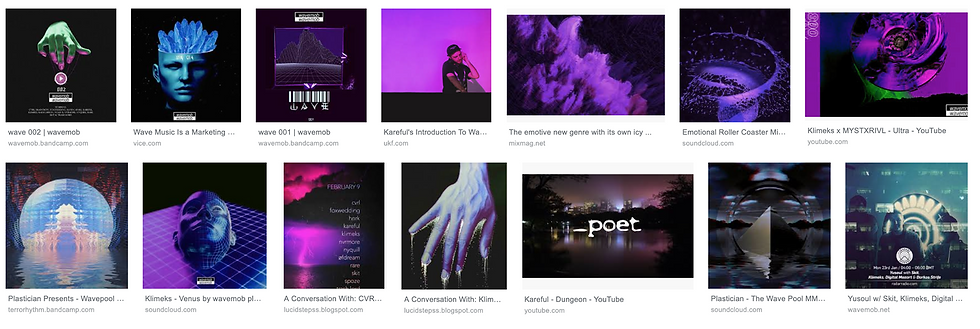
Wave Music Google Search
That being said, though I find the genres to be different there are some artists that blend between the two, for instance I find with Polish wave music artists, such as Enjoii, MYSTXRIVL and Sokos, that they lean more towards a harsher sound and have are included in many more witch house radio shows.
In an interview with Enjoii he mentions that “Poland has always been big into bass music. Up until recently it’s been trap and drum & bass. But when witch house came along it influenced the next generations. A lot of producers here are experimenting with wave”. (Jenkins, 2018)
Yet another genre that is often intertwined with wave music is Future Garage, which shares some of the same elements, particularly in the big reverbs, bassline and vocal chops. Future Garage artists could be considered to be those such as Burial or SBTRKT.
If we listen to a future garage mix, we can hear the use of noise such as vinyl crackles and pops, vocal chops, a deep sub bass and big reverb ambient sounds. It can be seen when searching on youtube that many wave music mixes will also say future garage in brackets, as the same with tutorials. When referring to Klimeks (who we will later discuss as being considered the original wave music creator) Kareful says that he is “a bit like Burial – he’s very low-key and mysterious” ("Wave Music: Why You Need This Genre In Your Life Right Now", 2016).
I find that what differs future garage from wave is the drums as future garage typically doesn’t use trap drums and the use of piano to play chords, something I’ve rarely come across in wave music. The drums are also playing a particular pattern of off beat percussions which are a big part to the future garage sound. That being said there are likely cases where the two will change, but thats expected as genres don’t always limit an artists creative choice.
Wave is quite an obscure genre and often times gets mixed up with other popular genres such as synthwave, new-wave or vaporwave which makes it hard to come across through search engines. Some wave artists (as is very common with Witch House artists) will use characters that are uncommon to stylise their names or song titles, such as the use of emoji’s or symbols accessed by pressing the alt key such as some shown below

("Alt Codes List of Alt Key Codes Symbols", n.d.)
These types of stylised characters are more so found in the lesser known wave artists rather than ones that can be found in the more mainstream or traditional collectives like Liquid Ritual.
Because it is internet born and artists are never really signed to official labels, wave tracks can sometimes disappear off the internet if an artist decides to delete it, so some songs can be gaining popularity but then it is gone one day. Some wave songs also sample other popular songs which causes them to get removed on platforms like soundcloud due to copyright. For example there was a popular wave track, “all my friends are dead” by Dyzphoria, which sampled the vocals from Lil Uzi Vert’s “XO Tour Llif3”, this has been removed due to copyright from Soundcloud and has been replaced with an instrumental version at the moment with the actual version found on Bandcamp or reposted on Youtube. This track also showcases an interesting effect that Wave music seems to have adopted from Witch House music, which is the changing of speed and pitch, we can hear at 1:42 the track slow down in a vinyl like fashion that alters the pitch as well, this is an effect that is used more often in Witch House than it is in Wave.
Evolution of Wave Music.
It’s believed that the term Wave was first coined by producer Klimeks, who is supposedly widely recognised as the “O.G of wave”. Here is an example of some of the earlier wave music:
I can’t really pick up that many differences as this could still definitely be a wave song released today, but from the looks of it, many producers started off by making Witch House or Future Garage. Some wave producers in the early stages of their discography had produced for a soundcloud rapper by the name of BONES, who is a somewhat well known (described by many as ‘sad rap’) artist racking up to 20 million views on some of his youtube uploads. Perhaps these collaborations drew in the soundcloud rap influence of wave music as the fanbase of Bones might have learnt about wave producers through him?
Since it’s still a very new genre there isn’t too much evolution to discuss as it’s really in its early stages of developing, however I have seen it grow in popularity and become might more established in just the last 3 years. Wave music has started to branch off into its own subgenres and categories with artists such as Australian producer 'Skeler' creating what he calls ‘Hardwave’ and a bunch of new “Neo-Trance” Artists creating wave music that has a lot more emphasis on trance sounds (including trance vocals) and visual aesthetics of cyberpunk imagery such as futuristic cities, computers, holograms etc.
A Skeler track had recently been played during a live DJ set of RL Grime on one of the main stages of EDC Mexico, one of the worlds biggest chains of electronic music festivals. This is quite a big step for wave music to be recognised by an artist as big as RL Grime and played at a festival as big as EDC.
Popular rapper Lil Peep had also collaborated with wave music producer Dyzphoria on his track with Bexey titled Night Slayer
Overall Aesthetic
Similarly to the Sadboy music scene, many wave tracks tend to have common themes of depression and forlornness. I find that it’s quite common to hear the terms “lonely” or “loneliness” in titles of wave tracks or artists. For example some names of popular wave artists with melancholic tones are those such as: Dyzphoria, Gloomy, henryisdead or Vacant, plus some collectives such as "Never Amount To Anything" to name a few. Artists in the wave music scene tend to also use forlorn cover art or song titles (however some don’t), for example Skeler uses a screenshot from the film Requiem for a dream in one of their song covers, a film which is sampled and mentioned somewhat frequently in the sadboy and wave scene, which is also considered by some to be one of the most depressing films ever made (the film is also known for its themes of hopelessness and lack of a happy ending) ("According To 3,300 Voters, These Are The Most Depressing Movies Ever Made", n.d.). Wave music often will have depressing lyrics on its tracks, or will have sampled a song with depressing lyrics or tone. In the example I mentioned before in the Kyddiekafka mix, the lyrics are saying “I just want to die” repeatedly, lyrics with content as such is a common motif in the sadboy music scene which is another area where they can also sometimes gel together as similarities withing the genre. We can also see similar things in “all my friends are dead” by Dyzphoria, who sampled Lil Uzi Vert’s “XO Tour Llif3”, which I also mentioned earlier, and In the track 'in the light' by NANCY DEAD, (which, yes, I also mentioned earlier) we can hear a sample of "Swim in the light" by Kid Cudi, a song written about depression.
Wave music, however, unlike Sadboy music often has a visual aesthetic of cyberpunk and city-like urban imagery. As can be seen from a screenshot I’ve taken off of liquid rituals Soundcloud profile, it’s quite common to see glitchy, neon artworks on wave tracks. The covers also commonly have large, futuristic looking cities on them, and FOMH a popular wave repost youtube channel sometimes has shots of urban environments in the beginning of their videos. In some songs we can also hear things such as city ambience samples or police sirens.
That just about sums up my genre analysis on the Wave Music Genre. The underground Soundcloud music scene is quite diverse, and I'm interested to see where Wave will go in the future (and if any other similar genres will spawn from it).
If you're interested to learn a bit more, check out my bibliography! A lot of time went into researching and I found some great resources.
Thanks for reading!
BIBLIOGRAPHY:
According To 3,300 Voters, These Are The Most Depressing Movies Ever Made. Retrieved from https://www.ranker.com/list/most-depressing-movies-of-all-time/ranker-film
Alt Codes List of Alt Key Codes Symbols. Retrieved from https://www.alt-codes.net/
Bruin, R. (2019). Bubblin' Up: Kareful. Retrieved from https://www.xlr8r.com/features/bubblin-up-kareful
Gross, E. (2017). Wave Music: The New Sound. Retrieved from http://epsilon144.com/?req=misc&page=a5
Hockley-Smith, S. (2017). Why It’s Time to Reconsider Witch House. Retrieved from https://www.vulture.com/2017/10/witch-house-music-salem-a-reconsideration.html
I am wave producer Skit. Ask me anything! : wavepool. (2017). Retrieved from https://www.reddit.com/r/wavepool/comments/5fs25u/i_am_wave_producer_skit_ask_me_anything/
Jenkins, D. (2017). Why Wavepool 2 is a critical moment for wave music. Retrieved from https://ukf.com/words/wavepool-2-critical-moment-wave-music/20023
Jenkins, D. (2018). Who The Hell Is Enjoii?. Retrieved from https://ukf.com/words/who-the-hell-is-enjoii/21246
Lawlor, S. (2018). In conversation with Kareful. Retrieved from https://www.theplayground.co.uk/in-conversation-with-kareful/
Mineo, M. (2018). Why Witch House is the Best Genre You've Never Heard Of. Retrieved from https://www.obscuresound.com/2018/04/why-witch-house-is-the-best-genre-youve-never-heard-of/
Moy, J. (2014). Sad Boys IRL: Depression Is Not A Meme. Retrieved from https://www.complex.com/style/2014/08/what-its-really-like-to-be-sad-in-real-life
Noble People | Kareful. Retrieved from http://www.noblepeople.london/people/kareful
Palmer, O. (2018). Original Reese Bass Tutorial. Retrieved from https://www.youtube.com/watch?v=8whhdvA0hV4&
Plant, S. (2017). Wave: The emotive new genre with its own icy ecosystem. Retrieved from https://mixmag.net/feature/wave-the-emotive-new-genre-with-its-own-icy-ecosystem/
Pringle, R. (2017). Kareful and the evolution of wave music. Retrieved from http://www.plasticmag.co.uk/reviews/kareful-evolution-wave-music/
SKIT & KLIMEKS // Azimuth. (2017). Retrieved from https://www.youtube.com/watch?v=trvqwEW8Y0I
Turkel, L., Turkel, L., & Turkel, L. (2018). Yung Lean is the OG Sad Boy. Retrieved from http://dailycampus.com/stories/2018/9/28/artist-spotlight
Vasquez, W. (2017). What Is Witch House?. Retrieved from https://beat.media/what-is-witch-house
Wave Music: Why You Need This Genre In Your Life Right Now. (2016). Retrieved from https://www.highsnobiety.com/2016/08/11/soundcloud-wave-music/
Zoladz, L. (2017). XXXTentacion, Lil Peep, and the Future of Emo. Retrieved from https://www.theringer.com/music/2017/8/30/16225968/emo-xxxtentacion-lil-peep-brand-new
Comments